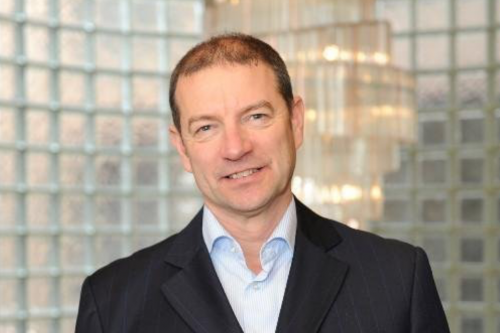
Sportsfields Interview with Martin Sheppard
With GO Sports Media Productions.
Martin Sheppard has been vocal about the integration of synthetic turf in our society for over 30 years. He feels encouraged by the latest innovations and recent R&D by the industry. At the same time, he warns that we must start designing synthetic turf fields differently if we want to continue enjoying their benefits, as the environmental sustainability voice grows stronger.
As managing director of his own consultancy firm that consults to municipalities all over Australia and New Zealand, co-founder of the Australian National Sports Convention and chair of the Outdoor Sports Surfaces Expert Circle of the International Association for Sports and Leisure Facilities (IAKS), Martin Sheppard is a familiar face on the international outdoor sports surfaces scene. For years, he has been advocating a smart integration of this type of technological surface in today’s society. “Anybody in local government who has a responsibility for a natural environment is a custodian for the future generations and the future generations are who we need to have synthetic surfaces for. The young of today across western civilisations aren’t physically active enough and the research is showing that globally.
Sedentary lifestyles was already starting to be an issue when I moved from the UK to Australia 30 years ago. The challenge is still ahead of us, and while many governments recognise this there hasn’t been a significant change,” he says recalling how synthetic turf saw the light in the early 1960s after the US Army realised that recruits coming from the countryside were actually fitter and healthier than their peers from the cities. “The army put that down to the amount of grass that was available in the countryside, which is why the US Government teamed up with Monsanto to develop a synthetic grass to replicate this in builtup areas, thinking it would encourage young people to be more active.”
Population growth
The need for the integration of synthetic turf into modern society is further fuelled by the way society is growing. “In the past 25 years, the Australian population has increased by 25% to approximately 28 million today, and it is expected to increase by another 25% in the next 25 years to 34 million. That is going to be a huge change on the natural environment to be able to cope with the demand of the additional population, particularly as they are predominantly going to be located around metro cities. However, we are finding that as our cities grow vertical to accommodate all those people, we are not investing in the amount of land that is needed to satisfy the physical activity of the people who choose to be active, never mind the people who are sedentary. That is where synthetic turf can add value.”
Taking critics seriously
Parallel to the growing recognition for the need for more synthetic turf pitches, environmental awareness within society has also increased. “There is a growing voice in the community who are very well aware of the benefits synthetic turf brings but who are also very well aware of the issues around that. Over the last decade, they have changed the view on synthetic turf. A decade ago, the emphasis was on SBR infill causing cancer and as we know now, there is enough independent research and surveys to identify that that is not true. The people who are anti synthetic turf have now shifted the narrative away from the cancer conversation to the environmental conversation. The key issues or perceptions that are becoming louder now are around microplastics, leaching, and the circular economy, as well as the issue around plastic.
“Anybody in local government who has a responsibility for a natural environment is a custodian for the future generations.” – Martin Sheppard, Smart Connection Consultancy
Many people in the industry identify that as a problem. My view is that we should embrace their narrative that they are providing us because if we embrace the narrative, we will actually design and manufacture better outcomes.” The removal of intentionally added microplastics from the synthetic turf system, he calls a good start. “But the industry is also looking at making the yarn a little bit more stable by putting in more UV-stabiliser so that it doesn’t break down that fast anymore in countries like Australia that has very high UV radiation. The industry is also looking at things like increasing the intensity of usability so that the yarns will need to last longer and so that we don’t have secondary microplastics. That is why I believe we should listen to the stronger voice in the community and identify the causes of their concerns as well as identify the effects of the surface, but then go to the cause of the impact and address that cause.”
Different view
Sheppard advocates that more designers of sports, parks and leisure facilities should change their mindset when designing facilities that will use synthetic turf. “As custodians of the parks and natural environments we should be creating masterplans for the whole parkland and not just the sports field. We should design solutions for the long term, at least 30 years. That will allow us to balance increased participation with environmental benefits, such as water harvesting the field of play water to irrigate the whole parkland, to expand the tree canopy to lower the Urban Heat Island impact and design specific strategies to lower the environmental impact to the parkland.” Sheppard continues: “if we understand the cause we can design around a challenge and not just design to treat the effect, which the EN Standard on microplastic migration does. Design to have a closed drainage system, so no migration into the waterways, pursue no ball splash to stop migration of infill.
By using a dual yarn system (monofilament and fibrillated tape) and a shock pad, the required volume of performance infill has been from 26kg/m2 to circa 4-6kg/m2, therefore so little in the field to migrate to begin with. We feel these solutions reduce the migration at the cause by 90+%. Having a 200 or 500mm concrete edge doesn’t address what the cause is. We should be smarter in what we are doing. We still predominantly only talk about the performance field, where we should be talking about landscape integration and about construction integration, and the environmental impacts of that.”
Pursuing higher standards
With hundreds of different synthetic turf systems that buyers can choose from available at international level for almost every sports, it is difficult for the buyer to separate the wheat from the chaff. If up to Sheppard, national governing bodies should pursue setting the highest possible quality standard as the benchmark for their country. “I am a great believer that, when you look at FIFA or World Rugby or FIH, they got to facilitate the development of systems at a standard which is acceptable across the globe. To me, that is the lowest common denominator, although I say that with absolute respect to these governing bodies. Some countries need those standards to be higher. Australia is one of those because of our UV and intensity of rain and the intended intensity of usage. What we have seen here in the last decade is the transition from importing yarn and carpets from Europe to a situation where we now have a number of carpet manufacturers in both Australia and New Zealand. We also have the three big players; Polytan, TenCate and Fieldturf all having their own production capacity here in Australia and New Zealand. For them to be competitive and with a desire to develop, they will have to align with a more holistic philosophy of environmental management, durability and intensity of usage.
We have worked closely with the key providers in Australia to ensure that all of them can provide for the future needs and from that we have developed specifications that will allow for far greater intensity of usage and the environmental aspects that we have designed and put in. When we started this, I used to have some arguments with suppliers claiming that you don’t need a shock pad but over time they have come around in their thinking, and by now. all the major manufacturers offer the dual yarns and shock pads with low performance infill with subsurface drainage.” Products are now tested between 200,000 and one million cycles on the old Lisport test. “It is the expectation that we now get onto the tender list. It cost a little bit more at the beginning, but in the longer term. I would say 30 years, it will make a huge difference.
I look at the return on investment through four lenses: the environmental return, the playability, the fit for purpose and the number of hours you can play on it. Most of our fields have more than 60 hours usage a week for 50 weeks a year. And it is not just 22 players on the field: it is a significant amount of players on half fields or a quarter of the field.”
Educating the masses
Sheppard is the technical consultant for most of the football clubs and to Hockey Australia, making it easier for him to encourage the industry as well as buyers to accept a more holistic approach. “However, I also provide free-of-charge a small guide to synthetic turf for football, and before the end of March, we will produce a small guide to environmental sustainability, while a maintenance guide for synthetics will come out early April. These are provided free-of-charge so that people in sports clubs and in local governments can have access to it. Once a year, we provide a series of workshops. I feel that my role is one of advocacy in the region, one of support and one of guidance.” All this is guided by one principle: “It is not about building a facility and expecting people to come. You have to provide a reason why people want to come and play.”
Bio Martin Sheppard
Education
1981-1984 Crew & Alsager College, HND, Sport & Recreation
1990-1992 Bristol University, Post graduate Diploma in Management Studies
Career
1990-1995 Swindon Borough Council, Head of Parks, Recreation and Arts
2000-2002 City of Melbourne, Head of Contracts, Parks and Recreation
2002-present Owner Smart Connection Consultancy
2016-present Co-founder, National Sports Convention
2018-present IAKS Chair, Outdoor Sports Surfaces Expert Circle