As the National Sports & Physical Activity Convention begins in Melbourne this week, the theme of The Next Generation feels particularly important.
It is easy for our industry to talk about young people as the future.
The more important point is that they are already shaping the present.
They are already participants, volunteers, casual staff, coaches, officials, creators, community voices and emerging leaders. They are already influencing how sport, recreation and community places are used, experienced and valued.
So, the question is not whether young people are interested…..
The better question is whether our systems, places and culture are ready to adapt.
In this edition of Smart Thinking, I want to share a preview of new work being released alongside NSC26, while also connecting it to one of the important environmental conversations we are continuing to explore: how sport, recreation and community places can be designed with people, biodiversity, climate resilience and lifecycle value in mind.
A first look at The Next Generation
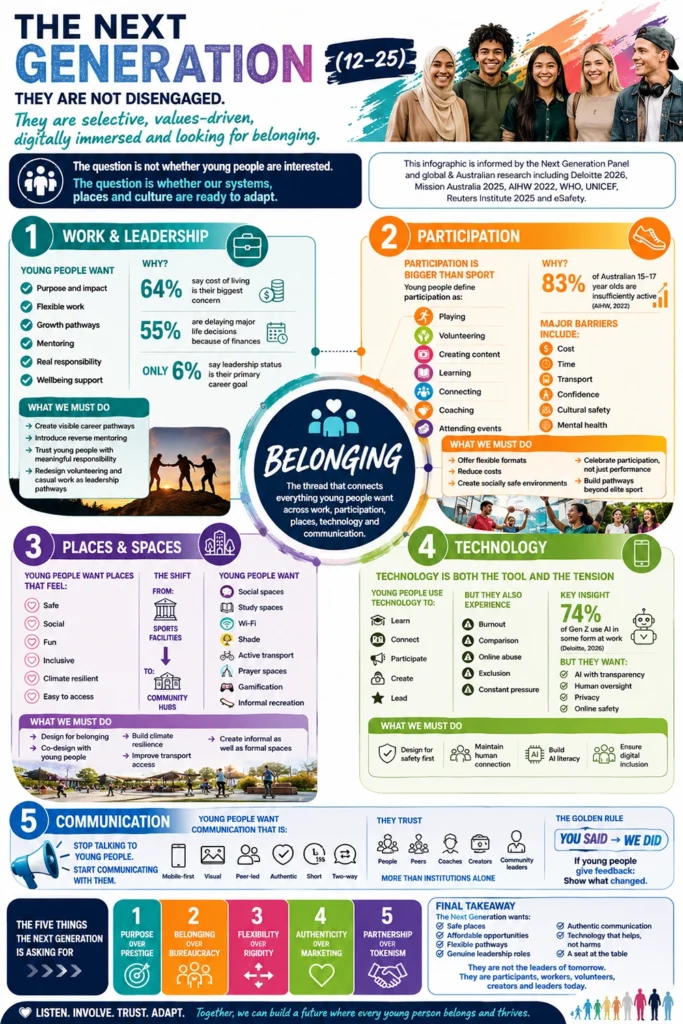
Ahead of the launch of the full Next Generation White Paper at NSC26, we have developed an infographic that brings together insights from the Next Generation Panel and supporting global and Australian research.
The white paper focuses on young people aged approximately 12 to 25 and explores five areas of interest to the sport, recreation and community infrastructure sector:
- Work and leadership
- Participation
- Places and spaces
- Technology
- Communication
Across each area, one theme keeps coming through clearly:
Belonging.
Young people are not simply asking to be included in existing systems. They are asking for systems, places and cultures that recognise how they live, connect, participate, work and lead….
- They want purpose over prestige.
- Belonging over bureaucracy.
- Flexibility over rigidity.
- Authenticity over marketing.
- Partnership over tokenism.
That is the shift our sector needs to understand.
From facilities to places of belonging
One of the strongest messages from the white paper is that young people notice whether a place has been designed for them, with them, or around them.
This matters because many sport and recreation environments have traditionally been designed around formal use: training, competition, fixtures, bookings, change rooms, lighting and compliance.
All of these elements remain important.
However, young people are also looking for places that feel safe, social, inclusive, flexible, climate-resilient and easy to access. They want environments that support informal recreation, connection, watching, volunteering, casual participation and community life – not just organised sport.
This means the planning question needs to expand.
Not just: What facility do we need?
But: What kind of place will young people trust, use and feel they belong in?
A sport and recreation place is not only a field, court, pool, pavilion or program.
It is part of the social infrastructure of a community.
If we want young people to keep showing up, the place itself needs to feel like it is inviting them in.
Belonging, biodiversity and the next generation of places
The next generation is also growing up with a different level of environmental awareness.
Climate, heat, biodiversity, water, materials, waste and circular economy are not abstract issues. They are part of the world young people are inheriting and the places they will be asked to use, manage and lead.
So when we talk about the next generation of sport and recreation places, we need to consider both sides of the equation:
Do these places support people?
And:
Do they support the natural systems around them?
This is where the conversation around synthetic sports fields needs to move beyond the surface itself.
A synthetic sports field does not improve biodiversity simply because it is synthetic.
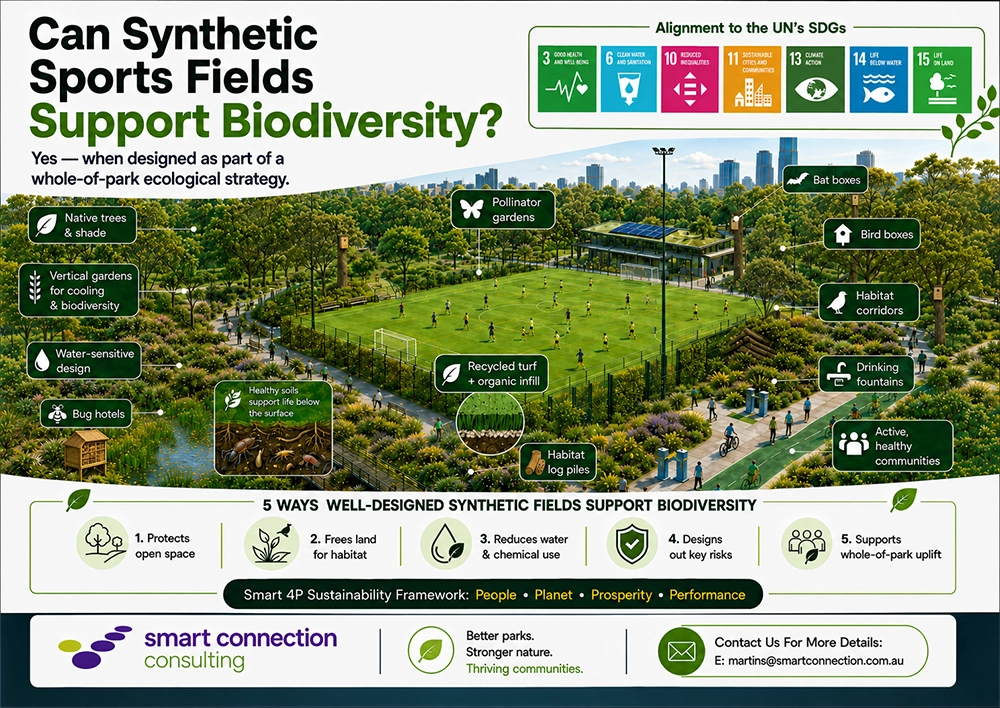
But when planned and designed as part of a broader whole-of-park ecological strategy, it can support a more constructive conversation about sport, nature, climate resilience and community value.
From field-of-play thinking to whole-of-park thinking
The biodiversity-positive synthetic field is not just designed as a rectangle field of play with landscaping around the edge.
It is designed as one component in a wider parkland system – where sport, water, shade, planting, habitat and community use are planned together.
This requires councils, planners, designers, managers, sports and communities to shift from field-of-play thinking to whole-of-park thinking.
In high-demand urban environments, a durable sports surface can concentrate intensive sport onto a smaller footprint. This can reduce pressure on surrounding open space and create opportunities for the wider parkland to perform better for biodiversity, climate resilience and community wellbeing.
That might mean more tree canopy, native planting, habitat corridors, pollinator gardens, rain gardens, wetlands, water-sensitive urban design, stormwater capture, shaded spectator areas, active transport links and clearer end-of-life planning.
The real biodiversity benefit is not the synthetic surface by itself.
It is what the whole parkland is able to become when the field of play, surrounding landscape and long-term management approach are planned together.
Under a whole-of-park approach, the design team asks better questions:
- Where are the existing ecological assets?
- Which mature trees, soils, habitat patches, drainage lines and wildlife corridors need to be protected?
- Can new canopy be planted without compromising the playing surface?
- Can harvested water support the surrounding parkland?
- Can the perimeter become a habitat edge rather than a hard boundary?
- Can access paths, car parks and spectator areas be redesigned to reduce heat and support planting?
This is especially important in urban areas where open space is scarce and demand for sport is increasing.
A natural turf field is not automatically biodiverse if it is compacted, overused, irrigated, fertilised and repeatedly renovated to meet community sport demand.
Equally, a synthetic field is not automatically negative if its purpose is to absorb high-intensity sport while the surrounding parkland is restored, shaded and managed for ecological value.
The design objective should be clear:The synthetic surface provides the durable sporting platform. The parkland around it provides the living system.
Together, they should deliver more sport, more shade, cleaner water, better habitat and a cooler, more resilient place for the community.
Designing out the risks
A credible biodiversity conversation also needs to be honest about risk.
Traditionally designed synthetic fields can create environmental issues if they are not properly planned, designed, procured, managed and renewed. The answer is not to ignore those risks.
The answer is to design them out.
This includes practical responses to microplastic migration, heat, runoff, flooding, poor drainage, light spill, weak maintenance practices and unclear end-of-life pathways.
For example, a best-practice field should consider organic infill where suitable, shockpads that reduce infill volumes, durable UV-stabilised yarn, physical containment, filtered drainage, shade, tree canopy, water harvesting and clear maintenance responsibilities.
The goal is not simply to cool the playing surface, contain material or manage water in isolation.
The goal is to design a better whole-of-park outcome.
This is also the focus of a new Biodiversity Smart Insight resource being released this week, which explores how synthetic sports fields can be considered as part of a broader ecological strategy when planned, designed and managed through a whole-of-park lens.
Stay tuned for more details on this resource and how it can support councils, planners, designers and sports to ask better biodiversity questions earlier in the project lifecycle.
This is where biodiversity becomes a planning, design, procurement and management issue – not a landscaping afterthought.

A practical lifecycle model
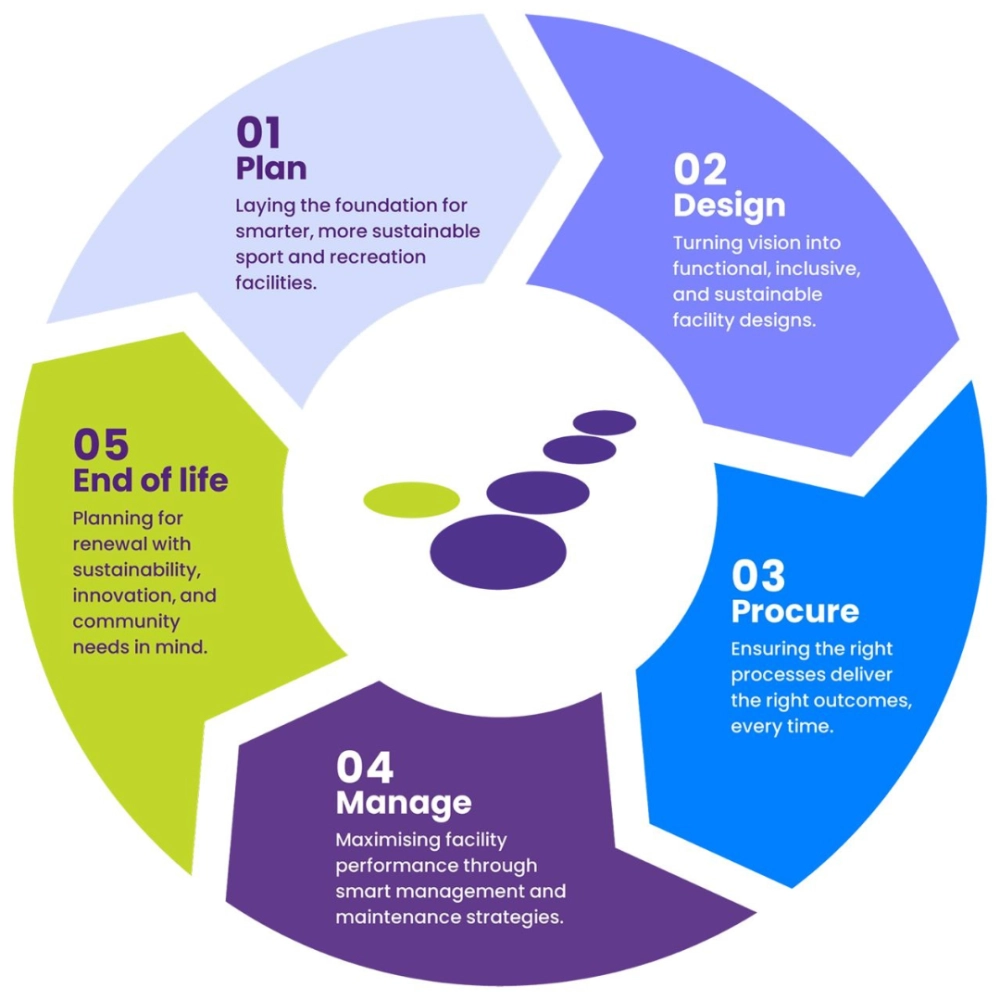
At Smart Connection Consulting, we continue to use the 5-phase lifecycle as the foundation for better decision-making:
Plan. Design. Procure. Manage. End of Life.
When applied to biodiversity and next generation planning, this lifecycle becomes especially useful.
Plan – Understand youth needs, community demand, ecological value, site suitability, access, heat, water, soil, shade, trees and whole-of-park opportunities before committing to a field footprint.
Design – Design the field and landscape together. Include canopy expansion, native planting, habitat corridors, water-sensitive urban design, cool materials, microplastic containment, shaded social spaces and safe access for active and passive users.
Procure – Specify environmental and community outcomes, not just sporting compliance. Require low-impact materials, recyclable components, drainage controls, heat mitigation, durability testing and proof of end-of-life pathways.
Manage – Maintain both the surface and the living landscape. Monitor infill and yarn wear, clean gates and drains, maintain canopy and habitat planting, collect debris and adjust management if biodiversity, heat or pollution issues are identified.
End of Life – Design for disassembly, reuse and recycling. Require evidence of processing so the surface does not become a future waste or pollution burden.
This lifecycle approach helps move the conversation away from short-term decisions and towards long-term community, environmental and performance outcomes.
It also reinforces a simple but important point:
Better outcomes are rarely created at the end of a project. They are shaped by the questions we ask at the beginning.
Smart Insights at NSC26
At NSC26, Smart Connection Consulting will also be releasing the next stage of its Smart Insights resource collection.
These practical insights have been developed to support better decision-making across the full lifecycle of sports surface projects, including planning, design, procurement, management, sustainability, biodiversity and end-of-life considerations.
Their purpose is simple….
To help councils, sports, schools, designers, planners and facility owners ask better questions earlier.
Because many of the outcomes we want later – better performance, stronger sustainability, lower lifecycle risk, improved community trust and clearer environmental accountability – are shaped well before construction begins.
The Smart Insight resources are designed to give the industry practical, digestible guidance that supports more informed conversations, more defensible decisions and improved planning.
Continuing the conversation at NSC26
This week at NSC26, I am looking forward to continuing these conversations across the Sustainable Sports Surfaces stream and the broader Next Generation program.
The full Next Generation White Paper will be released during the Convention, providing further insight into what young people are asking from sport, recreation and community places.
The Sustainable Sports Surfaces stream will also continue the discussion around planning, design, procurement, environmental responsibility, lifecycle management and the future of sports surface decision-making.
For me, these conversations are all strongly connected. The next generation of sport and recreation infrastructure needs to be shaped through a broader lens.
One that considers young people, participation, belonging, biodiversity, climate resilience, lifecycle planning and long-term community value together.
The challenge for our sector is not simply to build more facilities, for expanding communities…
It is to build better places….
Places that young people trust.
Places that communities value.
Places that perform for sport, nature and future generations.
That is the next generation of thinking we need.
Take a look at the NSC26 program here, and register to attend here.